Commercial food service spaces in dense urban hubs require structural containment rather than conventional surface spraying. Kitchens operating within historic brick row buildings in Fells Point, Federal Hill, and…
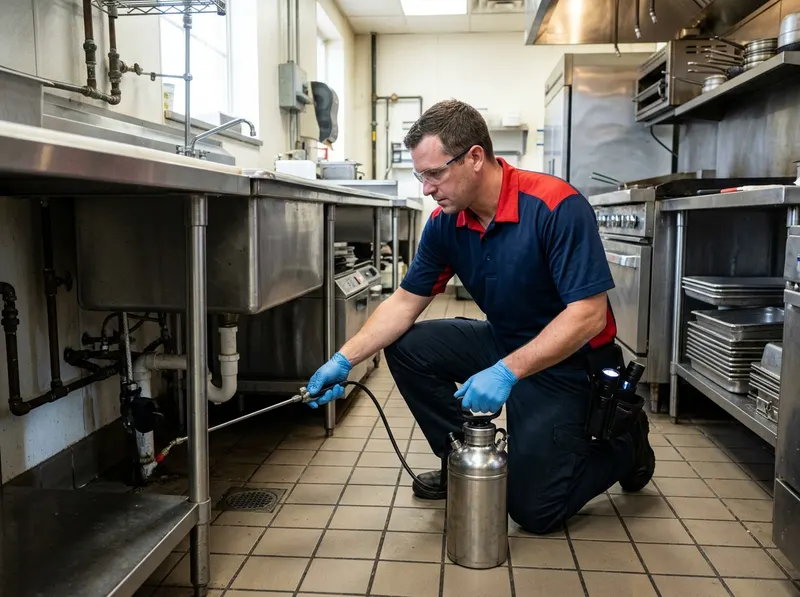
Commercial food service spaces in dense urban hubs require structural containment rather than conventional surface spraying. Kitchens operating within historic brick row buildings in Fells Point, Federal Hill, and Mount Vernon share structural party walls, exposed brick chases, and aging plumbing lines that allow German cockroaches (*Blattella germanica*) and rodents to travel freely between adjoining properties. A vector defense strategy isolates the food prep perimeter by mechanically sealing pipe collars, baseboard junctures, and floor-sink penetrations with silicone-polyurethane sealants and stainless steel mesh. This architectural boundary stops the continuous influx of pests searching for moisture and food debris.
Drain line biology represents the primary reproduction site for vector flies and crawling insects beneath prep tables. Standard mop water and bleach fail to penetrate the gelatinous sugar-and-protein biofilm that accumulates inside commercial floor sinks, trench drains, and grease waste conduits. Applying targeted bio-enzymatic foam digests this substrate down to the bare pipe wall, removing the food source and breeding ground for drain flies and phorid flies. In high-traffic districts such as Canton, Locust Point, and Hampden, maintaining dry, structurally sound wall voids beneath heavy equipment prevents pest nesting during operational wash-downs.
Regulatory compliance requires measurable non-pesticidal documentation that meets Baltimore City Health Department standards. Rather than spraying volatile chemicals near food prep surfaces, the protocol deploys insect growth regulators (IGRs) and sealed bait formulations that target insect reproductive systems while keeping surfaces compliant. For multi-tenant dining properties in Charles Village, Bolton Hill, and Roland Park, managing trash corral entry routes and exterior dock thresholds provides external defense, while internal non-toxic monitoring stations establish pest-free baseline metrics for municipal health inspections.
Every job gets a firm, written price after a free on-site visit.
Tell us about your commercial kitchen vector sanitation defense job in Baltimore and we'll send a clear, written quote, usually the same day.
 Elvaris Pest Solutions